• Skip to main content
  • Skip to header right navigation
  • Skip to site footer

+1 888 767 9990

Material Studio Login

9Wood

9Wood

Home Custom wood ceilings made fast.

  • Products
        • Custom made fast

          Go to Grilles
          Go to Linears
          Go to Acoustics
          Go to Nanoperf
          Go to Tiles
          Go to Cubes
          Go to Waves
          Go to Hybrids
          Go to Baffles

          Product Systems

          Products by Series

          Products by Function

          Material Studio

  • Products
    • Custom Made Fast
    • Grilles
    • Linears
    • Acoustics
    • Nanoperf
    • Tiles
    • Cubes
    • Waves
    • Hybrids
    • Baffles
    • Products By Series
    • Product Systems
  • Inspiration
        • Species
          • Solid Hemlock
          • Cherry
          • Walnut
          • White Oak
          • White Maple
        • Conditions
          • Fixtures integration
          • Lighting
          • Wall products
          • Scrim & fabrics
          • Accessibility
          • Ceiling to wall transitions
          • Trim matching
          • Clouds
          • Exterior
        • Project Archives
          • Grilles
          • Linears
          • Acoustics
          • Tiles
  • Sustainability
    • Sustainability
    • Sustainability action plan
    • AIA Materials Pledge
    • Guidance for LEED v4/v4.1
    • Green building systems
    • Certified wood
    • Essential documents
    • HPD repository
    • EPDs
  • Resources
    • Toolbox

      Material Studio
      Species and Finishes
      Standard Stain Colors
      Data Sheets
      Install Guides
      Guide Specs
      Acoustic Tests
      CAD / Revit Models
      PDF Details

      The Field Guide

      5

      Bidding, Submitting, and Installing

      4

      Detailing and Documenting Design

      3

      Specifying – Making Design Decisions

      2

      Specifying – Meeting Performance Requirements

      1

      Researching Wood Finishes To Meet Design Objectives
  • Resources
    • Toolbox
    • Material Studio
    • Species and Finishes
    • Acoustic Tests
    • Guide Specs
    • CAD / Revit Models
    • PDF Details
    • Data Sheets
    • The Field Guide
    • Researching Wood Finishes To Meet Design Objectives
    • Specifying – Meeting Performance Requirements
    • Specifying – Making Design Decisions
    • Detailing and Documenting Design
    • Bidding, Submitting, and Installing
  • About
    • Custom approach
    • Our people
    • Our story
    • Sustainability
    • Career opportunities
  • Contact
    • Contact 9Wood
    • Order a Sample
    • Request a Quote
    • Find a Rep
    • Schedule a CEU Presentation
  1. Home
  2. Blog
  3. Acoustic Wood Ceilings

Acoustic Wood Ceilings

Types of acoustic performance

In blending science and art for room acoustics, nothing compares to the expert advice of an acoustical engineer. Our goal is to provide wood surfaces that meet the designer’s intent while achieving the consultant’s recommendations.

Wood is acoustically warm and organic.

Consistent with good acoustics is employing the correct ceiling surface to tonally complement the sound performance of a space. The wrong material, such as metal, can impart a “tinny” or “metallic” signature to the sound. Plastic and fiberglass tend to be “drummy.” On the other hand, wood is acoustically warm and organic — one reason acoustic instruments are normally made from wood.

9Wood products offer two distinct types of acoustic treatment: Absorption or Diffusion.
Absorption

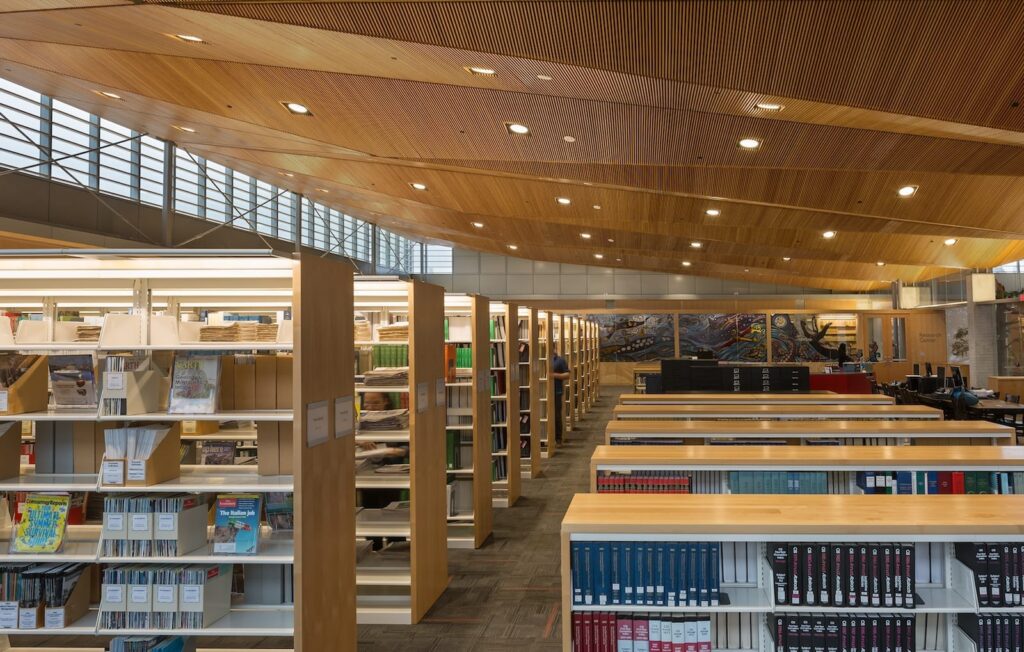
Wood surfaces are naturally reflective with an NRC (Noise Reduction Coefficient) of .05-.15. Absorption may be desirable in spaces where acoustic energy would have a negative impact on occupants, such as education and healthcare settings.

High levels of sound absorption (NRCs of .65–.90) can be economically achieved by means of strategically placing openings in the ceiling. This allows acoustic energy to pass through the ceiling into acoustically absorptive material hidden in the plenum.

Perforations, reveals, or grooves allow for a percentage of sound energy to pass through the wood ceiling and be absorbed by fiberglass acoustic backing material. In general, the thicker the fiberglass backing (3-6# density, 1″ to 6″ thick) the greater absorption will be achieved, especially at problematic lower (bass) frequencies.

9Wood 3000 Series Acoustics and 5000 Series Perf Tiles create tuned resonant sound absorbers. This means they provide peak absorption at certain problematic (typically mid-range) frequencies. These products can achieve NRC ratings of up to .90 NRC. Higher NRCs usually require supplemental fiberglass backing.

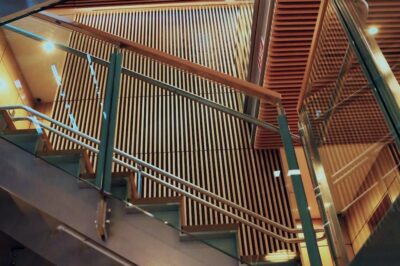
Because absorption is directly related to the percentage of open area in the ceiling, 9Wood Grille and Linear products can most easily achieve the highest NRC ratings.

Diffusion

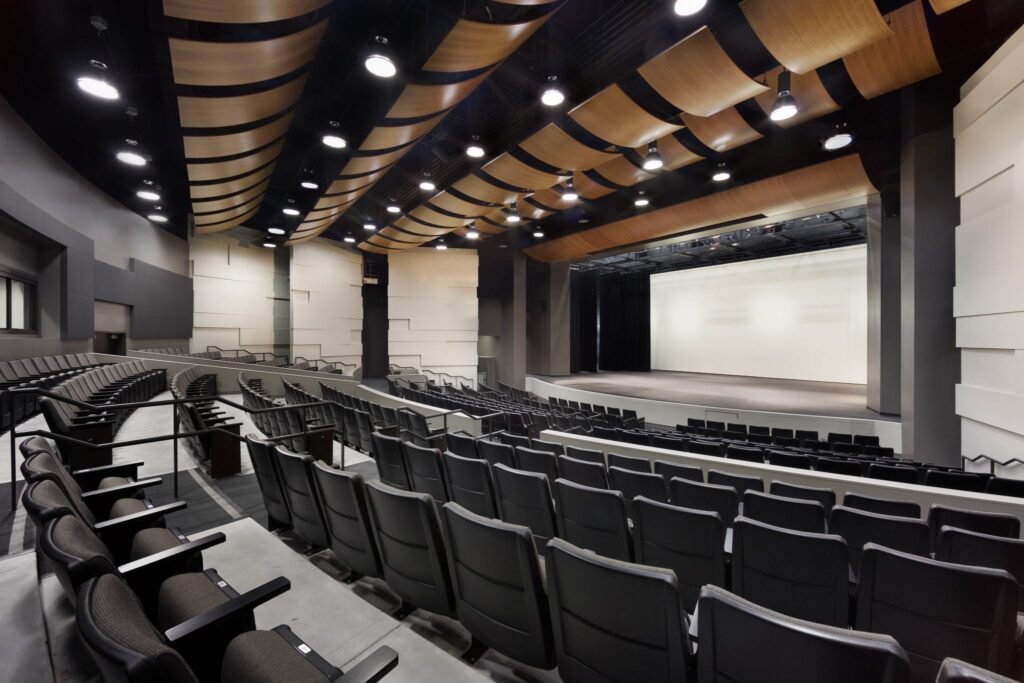
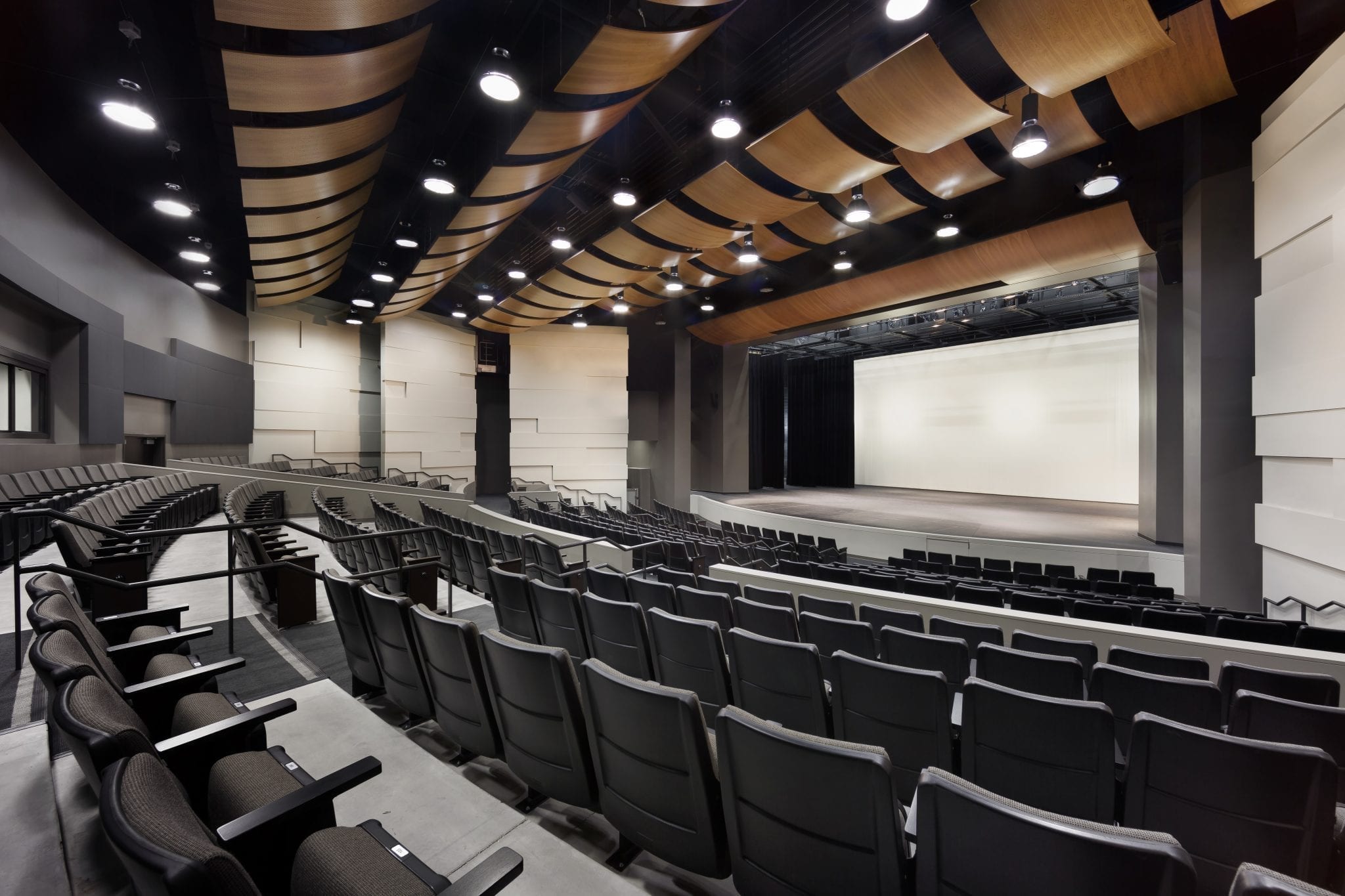
Diffusion, the scattering of reflected sound, can be achieved by means of a wood wave tile (a curved surface) or scattered by means of irregular surfaces like wood grilles or cubes.

Diffusion can be highly desirable in spaces where sound needs to be more “live,” but problems with echo, ring and “slap” need to be avoided. Performance arts halls, houses of worship and lecture spaces are often served well by acoustic diffusion.

Whole-space performance

Often a space will need a careful combination of absorption and diffusion to function as it should. By offering a variety of beautiful wood products that provide either absorption or diffusion, we strive to leave as many design options available to the architect as possible.

9Wood has a number of products acoustically-tested in a third-party lab. Check out our Acoustic Tests to see the downloadable reports.

You may be Interested

4 min read

Color Variation

A wood ceiling brings natural and organic warmth to a space. Just as the variegation of a wood floor adds to its appeal, the spectrum of color and grain offers a unique aesthetic in any design. These aspects therefore should be considered when designing with wood ceilings. Wood’s intrinsic color range provides a one-of-a-kind visual …

Read moreColor Variation

10 min read

What are the Types of Suspended Acoustic Ceilings?

A suspended acoustic ceiling is a secondary ceiling, hung below the structural ceiling both to treat room acoustics and to look attractive. 

Read moreWhat are the Types of Suspended Acoustic Ceilings?

4 min read

Does 9Wood do Exterior Wood Ceilings? [VIDEO]

We asked one of our lead engineers, Nathan Pfeifer, to give us the answer. Nathan talks through design considerations, limitations, and of course the possibilities of exterior wood ceiling applications. Q: Does 9Wood do exterior wood applications? “A question we get quite often, is whether or not we can do exterior applications with our wood …

Read moreDoes 9Wood do Exterior Wood Ceilings? [VIDEO]

Can we help?

Our team of devoted wood specialists are always on hand and happy to discuss how we can support you.

Get in touch
  • Instagram
  • LinkedIn
  • YouTube

Our products

Custom made fast products

Custom approach

Product systems

Traditional custom service

Projects for inspiration

Conditions gallery

Species gallery

Resources

Sustainability

Guidance for LEED

Pricing guide

Species and finishes

Standard stains

Field guides

CAD/Revit models

The company

Our people

About us

Sustainability action plan

Career opportunities

Learning center

Secure Pay

Terms | Privacy | Cookies

999 South A Street, Springfield, OR 97477

© 2026 9Wood | All rights reserved. | FSC® License Code FSC-C012655. The contents, graphics, design and other matters related to this site are protected under applicable copyrights, trademarks and other proprietary rights. You have a limited license to use the site solely for internal, personal or non-commercial purposes and to print out information from the site solely for internal, personal or non-commercial purposes provided you maintain all copyright and other policies contained therein.

9Wood rocketDon’t forget the crackers! We use cookies to offer you a better site experience and to analyze site traffic. Read about how we use cookies in our privacy policy. If you continue to use this site, you consent to our use of cookies.