

How Much Does a Custom Wood
Ceiling Cost?
“How much does a custom wood ceiling cost?” is one of the first questions architects and contractors want to know when they reach out to 9Wood.
Although this is a difficult question to answer in an article, we will do our best to discuss the factors that affect custom wood ceiling pricing. In this guide, we’ll break down material cost ranges per product series, provide some guidelines for installation costs, explain the key cost drivers that affect the price per square foot (SF), and give some examples of our more economical options.
The price of a custom wood ceiling has two primary components:
Material
Raw materials, fabrication, freight to job site
Installation
Installation labor and suspension (heavy-duty T-bar, drop wires, etc.)

Total Installed Cost = Material + Installation
When operating in a metropolitan area, a good general rule is to double your material cost to get your Total Installed Cost. While this varies widely across the country, this general guideline should cover everything a subcontractor will need to install the finished ceiling.
The incredible thing about specialty materials, such as ours, is the potential to bend the rules of architecture and design. The wide variety of suspended wood ceiling options naturally leads to price ranges for materials that can vary significantly.
The multitude of possibilities can also add time to the pricing process, but a wood ceiling manufacturer should be able to provide a quote for your project within 2 business days of receiving architectural plans and specifications.
9Wood Products – Material Cost Ranges $/SF
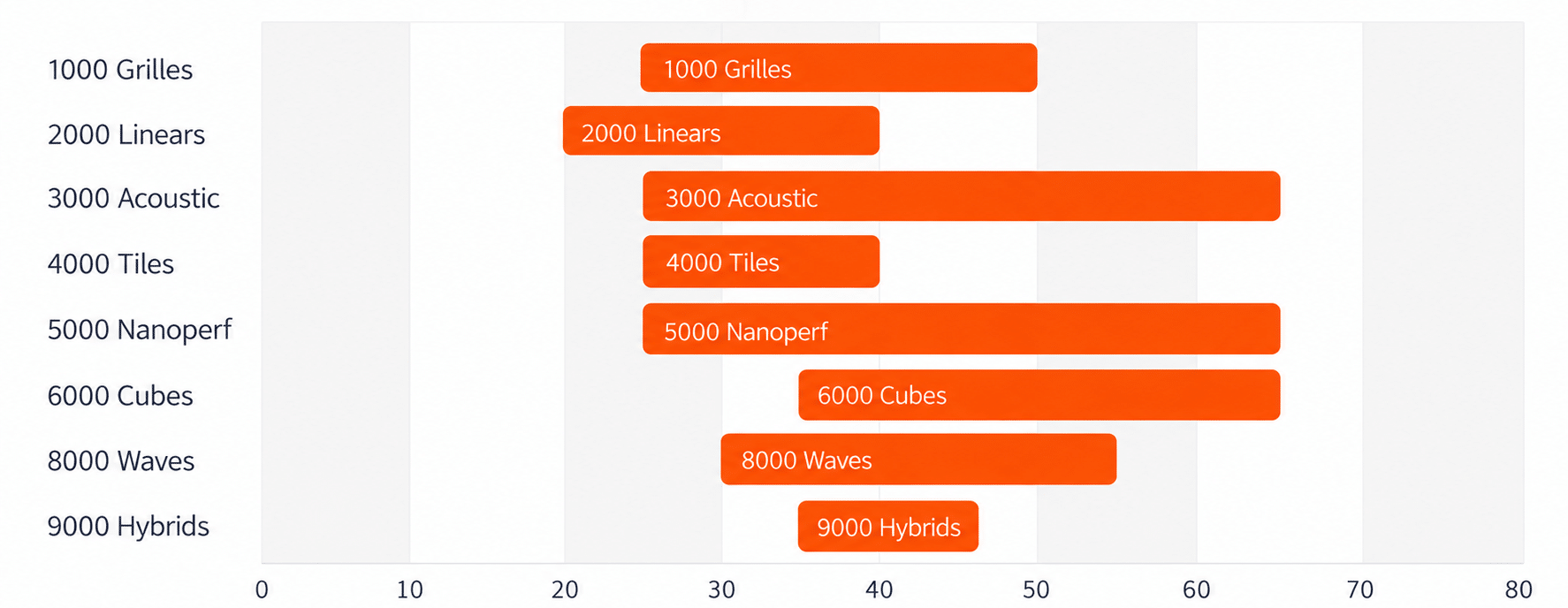
The chart above provides general price ranges for each of our wood ceiling product series. The Material Studio offers more specific pricing if product details are available. Pricing does not include suspension grid or acoustical backing.
At this point, you’re probably wondering…
What are the primary cost drivers for material?
Our Design Assist Specialists will help you consider several key factors:
Lengths & Dimensions
Using industry-standard dimensions such as 8’ panels instead of 9’ panels or 4’ tiles instead of 5’ tiles can reduce material waste and lead to big savings.
Wood / SF
Depending on your series and overall product assembly, the more wood per SF, the higher the cost of a wood ceiling.
Exterior vs. Interior
Sealing and protecting the wood for exterior environments, such as a soffit, requires additional processing steps and treatment time. This added level of protection comes with a premium.
Species
Solid hardwoods are expensive, followed by a hardwood veneer or solid softwood. Veneers and softwoods can be in the same ballpark, depending on the product.
Fire Rating
All components in our products are fabricated using Class A materials. In some exterior situations, fire rating may not be required by local building codes. If not needed, removing the specification can result in minor cost savings.
Stain & Finish
We offer three primary finish options: Clear, Stain, or Opaque. A clear finish will almost always be less expensive than a stain on the same species. Our team can match any custom color. Just send us a color control.
Project Scope
No job is too small for 9Wood, but production runs for smaller jobs sometimes incur additional set-up costs. This generally applies to veneers (which are produced in full sheets) or custom-shaped products.
Logistics & Add-Ons
Trim
Trim can be included in a quote, depending on the product application and unique reveal or wall integration challenges. Trim is priced per Linear Foot (LF) rather than SF and is usually secondary to the main quoted product.
Freight
We’re located in Springfield, Oregon, the heart of wood territory. Freight cost depends on the number of shipments, their size, and the distance shipped. Calculating freight is easy once your product specifications, scope, and job site location are known. Our proposals include an estimate based on these factors and unless a project’s scope increases, we invoice for this amount when the project ships.
Accessibility
The level of access needed above the ceiling can have a cost impact. Spot access (needing access panels every 500 SF or so) is much more cost-effective than requiring full access with every panel.
Complexity of the Space
Critical lighting or lighting integration might require additional factory solutions or extra field installation work to ensure the design intent is delivered properly. Complex curves, angles or multi-plane applications would fall in this category.
Hardware & Acoustic Backing
Many products have options for factory-installed attachment hardware or acoustic backing. Not only does this reduce the time needed for installation, but it also reduces contractor labor in the field.
Schedule
Schedule is one of the key advantages of Custom Made Fast. 9Wood offers species and product configurations across two lead-time categories: 3–6 weeks or 8–10 weeks following approved submittals. Because material and product selection can affect lead time, we recommend sharing project schedule requirements with 9Wood early in the process.
Custom Made Fast is designed around predictable, reliable factory lead times, helping contractors plan procurement and installation with greater confidence. 9Wood maintains a 98% on-time shipment record.
Major Consideration: Field Customization
With Custom Made Fast, 9Wood offers thousands of product configurations, giving customers flexibility to tailor the system to each project. Products are then manufactured in standardized lengths and configurations, and the installer completes final fitting and adjustments based on actual field conditions.
For estimators, this means field labor for customization should be included when estimating the total installed cost of the ceiling. Depending on the product and project geometry, field customization may include:
- Cutting panels to length
- Fitting material at walls, perimeters, fixture penetrations, and other field conditions
- Touching up or finishing exposed cut surfaces
- Removing factory attached hardware and reattaching for field cuts
Veneered products may require an additional step. Because field cuts can expose the composite wood core, cut edges typically need to be finished with site-applied edgebanding. Estimators should account for this additional labor when comparing veneered and solid wood options.
Custom Made Fast avoids the coordination and production time associated with factory cutting to as-built dimensions. The result is a shorter, more reliable factory lead time, with field customization incorporated into the subcontractor’s installation plan.

What are the most economical options?
Progressively installed Linear systems using commonly available species are the most budget-friendly. Here are two projects that are economical overall and were less expensive than comparable panelized or grille options.

The first, Graland Country Dry School in Denver, CO used a 2300 Continuous Linear with a stained white oak veneer.

The second, Hyde Square in Bellevue, WA used a 2400 Tongue & Groove Linear with a solid western hemlock.
Architects have used both of these styles to achieve amazing results, and we frequently see designers select these products as their Basis of Design.

Check out: Built On Curves: An Award Winning Case Study using the 2300 series. The Bighorn Clubhouse in Palm Desert, CA used a Continuous Linear with a stained walnut veneer.

–Another Award Winner: 2018 CISCA Award of Excellence: State Farm Arena. The State Farm Arena in Atlanta, GA used a Continuous Linear with a stained white oak veneer.
A final word on custom wood ceiling costs:
This article just scratches the surface of pricing realities. The cost of a wood ceiling is not a simple question, nor does it have a simple answer. Hopefully, this gives you options for how a custom wood ceiling could fit into the budget for your next project. We love working with Architects and Designers and are always ready to provide design assistance, samples, and quotes for your project.
Get a Quote

 Don’t forget the crackers! We use cookies to offer you a better site experience and to analyze site traffic. Read about how we use cookies in our